

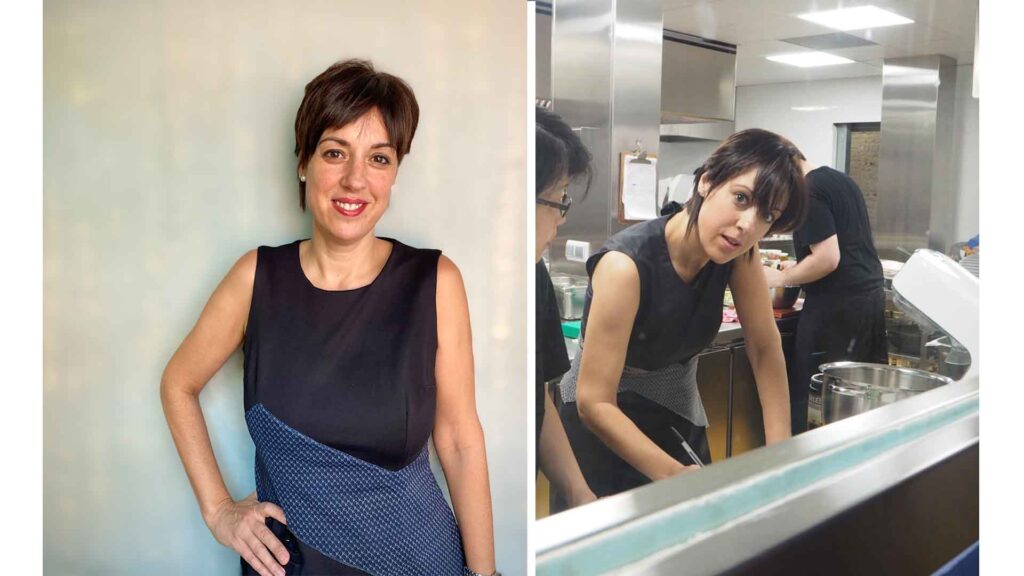
Interview with Sònia Profitós
The original blog posts are written in Catalan; the Spanish and English translations are automatically generated.
“Every day we can do a little more”
Front-of-house manager and co-owner of alkimia and alkostat
Sònia Profitós has spent almost thirty years working front of house * She wanted to be a nurse, but in the end she chose to study at the Lleida Hospitality School * At 21 she was already opening a restaurant: l’abrevadero, with our favourite chef, Jordi Vilà; then came alkimia and alkostat. * She has grown up among services, adrenaline and demanding guests. * She champions a dining room in tune with the kitchen and service that never lectures. * To this day she is moved when someone leaves the restaurant happy.
Why did you go into the restaurant business?
I wanted to be a nurse, but my mother used to say it would affect me too much. Caring for the sick takes a special kind of strength; I’m very empathetic and it’s true I might have suffered. In hospitality, on the other hand, I found another way of caring for people, simpler and less harsh, and it was also a chance to make people feel good.
Where did you train?
At the Lleida School of Hospitality and Tourism. I studied there for five years. In the first three you do a bit of everything: kitchen, dining room, management. Then you choose. And I chose the dining room.
Why? What drew you to front-of-house service?
I like talking, direct contact with people, being out front. It’s part of my character. And in the dining room every day is different: things happen, there’s a rhythm and you get that service adrenaline I’m hooked on. I never felt entirely comfortable in the kitchen.
Were you a good cook?
Yes, and people told me so (laughs). My teachers were sorry I didn’t stay in the kitchen, but I needed contact with the guests. The kitchen is essential, we all know that, but my energy was out front.
Has understanding the kitchen helped you as an owner?
A lot. Even though running a business is far more complex than the theory, knowing what goes on inside has helped me coordinate the teams better. Kitchen and dining room must always work as one.
Where did you start working?
In very hard-working places in Lleida: neighbourhood bars, set lunch menus, like the La Mina bar-restaurant, big dining rooms. Places where you learn discipline, speed and the trade. Then I moved to places more focused on produce, more refined. Like Jean Luc Figueras, Joan Piqué or Casa Irene… And right after that, still very young, we opened the Abrevadero with Jordi. I was 21.
And then alkimia, and then alkostat… What still moves you after almost 30 years in the job?
The connection with people. Sincere gratitude. Someone telling you they’ve been happy in your house. And also staying active, being part of the food scene in Barcelona and Catalonia, doing things, evolving. There’s a lot of work behind it and seeing it bear fruit is moving.
What, for you, is good service?
Complete harmony between kitchen and dining room. Genuine teamwork. Nobody can rescue bad cooking, but bad service can ruin the finest cooking. And, above all, sincere and professional attention.
How do you handle complaints and conflict?
It may sound wrong, but the customer isn’t always right. Even so, you must always listen to them. Experience teaches you that the first thing is to make them feel heard. And to stay calm. Composure is key to making good decisions. Luckily we don’t get many complaints, but sometimes we do, usually when you least expect it, just when you’ve started to relax.
A recent example?
A guest said the alkostat’s tub gurnard suquet (Catalan fish stew) was cold and bland… and had eaten almost all of it. There’s no need to go to war. They aren’t the only guest in the room. Service is easy when everything goes well; professionalism shows when there’s tension.
Is it an attractive profession for young people?
Less and less, because it’s demanding. But if you love it, it’s wonderful. You can grow a lot, be part of great teams, travel, specialise in wine… It’s a very rich profession and in high demand. Perhaps we need to explain it better.
Have guests changed?
They’re demanding, and I think that’s normal. As demanding as ever. We have to rise to it. Every house has its own philosophy, but high standards are there and must be there.
What is your service philosophy?
First of all, never lecture. We explain the context of the dish, the produce, its connection to the land, but briefly. If guests want to know more, they always ask, and then we can go into a little more detail. We’re very aware that they’ve come to spend time together, and the conversation at the table is also part of the magic. We should intrude as little as possible.
What has caused you the most anxiety at work?
I’d say my pregnancy. For a while I couldn’t come in to work and I found it very hard. I’m a responsible person and I know that behind every service there are salaries, suppliers, teams… Everything is more complicated than it seems, and not being able to help stressed me out quite a bit. There’s a lot of work behind every dish that reaches the table.
Any advice for future front-of-house managers?
Knock on the door of the restaurant where you want to work. If you show you’re keen, they’ll give you a chance. I’m sure of it. From there, it’s all up to you.
And the dining room… what has it taught you about life?
How to live with Jordi (laughs). We’ve shared a profession and a life for almost 30 years. We’ve always wanted to learn. And even today I think we can do it a little better, that every day we can do a little more.
In the photographs, Sònia Profitós today and in the week alkimia opened on Ronda Sant Antoni, 10 years ago.